

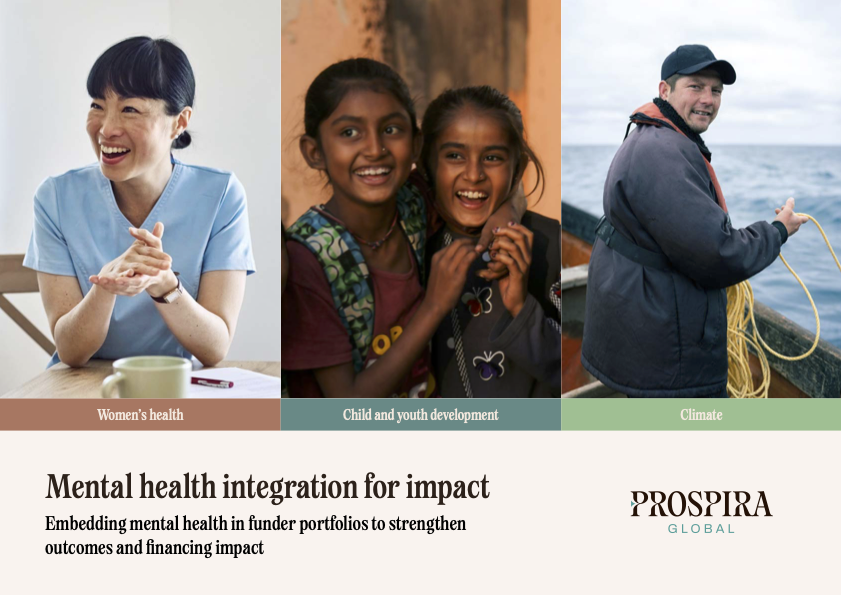
Mental Health Integration for Impact examines how embedding mental health within existing funding portfolios can strengthen outcomes across sectors.
This landmark study aims to move the global ecosystem from rhetorical alignment to measurable action by mapping the specific conditions and financing mechanisms required for high-quality integration.
It identifies key trends and opportunities for funders to shift from siloed investments toward a "finance-first" approach, providing practical tools to help philanthropists and investors operationalise mental health as essential infrastructure for impact.
Examples are provided across key opportunities for impact in women’s health, child and youth development, and climate resilience.
Executive Summary
Mental health is not a niche issue within global health or social policy. It is a cross-cutting determinant of whether funding strategies achieve their intended impact.
Amid significant global challenges such as climate shocks, geopolitical change, conflict, and technological change, funders are directing substantial resources towards resilience, health, and systems strengthening. Yet mental health, which shapes people’s ability to cope, learn, adapt, and participate, is still too often treated as peripheral rather than foundational.
This report calls for a shift in how portfolios are designed: from viewing mental health as a standalone programme area to recognising it as an enabling function across sectors and contexts.
Mental health intersects with nearly all global priorities. This report focuses on three strategic entry points: women’s health, child and youth development, and climate. These were selected because they combine substantial and growing funding flows, strong evidence of bidirectional linkage between mental health and sector outcomes, and real opportunity for funders to shape how integration is structured before norms consolidate. These are not the only possible entry points, but three domains where the conditions for integration are already in place.
This report examines these three domains as practical entry points for integration, unpacking how mental health interacts with women’s health systems, child and youth platforms, and climate resilience financing in distinct but overlapping ways. It finds that:
While interest in integration is widespread, in practice this is often informal in nature and unfunded.
Financing structures and measurement frameworks have not yet evolved to support consistent implementation.
Across the pillars, integration has progressed furthest at the service level, but remains fragmented at portfolio and system level.
Drawing on examples from funders already embedding mental health within sectoral strategies, the report identifies the conditions that distinguish credible integration from rhetorical alignment and sets out the funding design, measurement approaches, and system-level shifts required to move from pilot activity to sustainable scale.
The consequences of this uneven integration are visible across all three domains. Untreated depression, trauma, anxiety, and severe mental health conditions undermine maternal and reproductive health outcomes, early childhood development, educational attainment, adaptive capacity, and social cohesion. Addressing mental health within funding strategies is therefore not an add-on, it is a means of strengthening effectiveness and equity. Scaled treatment for depression and anxiety has been shown to lead to economic benefits of between $2.3 USD and $3 USD for every dollar invested, demonstrating that integration is not only strategic but economically sound.
Integration opportunities across featured in the report:
Women’s Health
Integration is most developed at the service level, linking mental wellbeing directly to maternal and reproductive outcomes.
Child & Youth Development
Moving beyond clinical settings to embed support within the daily systems where young people live and learn.
Climate Resilience
An emerging frontier - positioning psychosocial support as essential infrastructure for global climate adaptation.

Sector specific briefs
Integration is most developed at the service level, linking mental wellbeing directly to maternal and reproductive outcomes.
High impact areas include gender-based violence (GBV), perinatal and maternal care, and sexual and reproductive health (SRH).
Women’s Health

Moving beyond clinical settings to embed support within the daily systems where young people live and learn.
High-impact areas include early childhood, education, community-based programs, and safe digital spaces.
Child and Youth Development
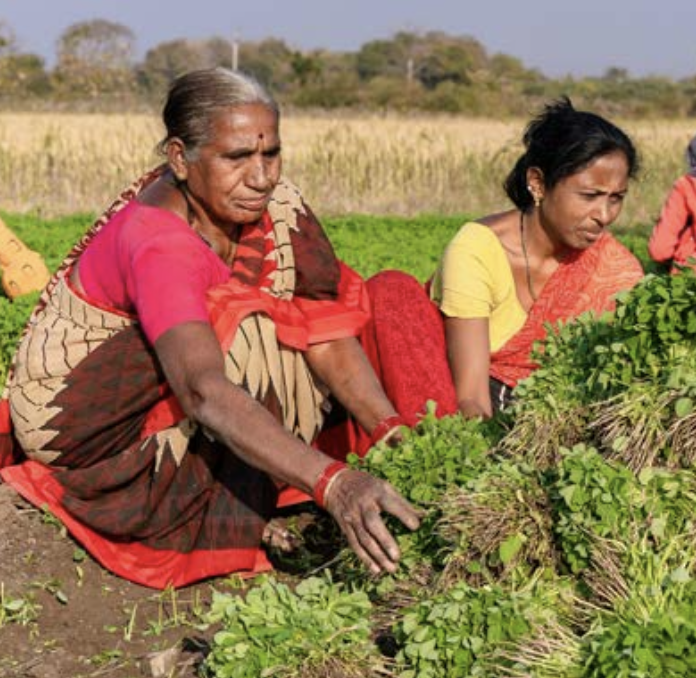
An emerging frontier - positioning psychosocial support as essential infrastructure for global climate adaptation.
High-impact areas include loss and damage, climate resilience, and disaster prevention.
Climate Resilience
“Governments and innovators work so hard to ensure a safe delivery, only for a mother to then suffer severe depression or even [die by] suicide … unless we are training nurses and community health workers to identify these issues and refer patients to specialists, women are left behind.”
Funder roundtable participant
“You need resilient people for climate resilience. And part of that is not just skills and tools and technologies, but mental health.
So it’s not icing on the cake. It is the cake.”
Gary Belkin, Director of Billion Minds Institute
With thanks to our partners


Spread the Word
Please join us in sharing your thoughts on the research with colleagues, friends and on social media.
You can download the communications toolkit here.
Or, please contact sam@prospira.global for any additional support you would like to offer to share these research findings funders, media, companies and advocates around the world.
We’d love to hear from you
If you have any feedback on this research, or it has supported you in your work, we would love to hear from you.
Please share any feedback or stories of impact below you wish to share with us. Your feedback will only be shared publicly with your permission.
If you are a funder that has been missed from this year’s report, please do let us know, and please register to join our global funder portfolio.
